Haley: I like that she added the parts about India and the Stupa.
Katie: This post used a good paragraph form, keeping the paragraphs small so I like reading them still.
Wednesday, February 24, 2016

China
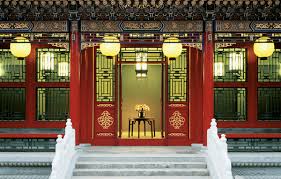
One of the most important part of Chinese architecture is the Great wall of China. This wall runs 5500-13000 miles. This was made of lots of different materials including brick, stone, mud, brick and earth. This great wall was made along to border and was made to protect the boundaries of China. This influenced the architectural aspect of watchtowers to keep have an added protection to the towns. The interiors of the Chinese are highly based on the colors red and gold. The furniture is very unique too because they typically sat on the floor and that made the tables very short. This is called a Kang table and it was made out of Huali wood, lacquer, bamboo and ceramic. (shown below)

Another piece of furniture they use is when they finally did make chairs they made some more progressive folding chairs. They also have a very iconic piece of furniture called a Yoke Back chair, this is something that is still relevant today.

Current Applications:

Extra Credit Video:
https://www.youtube.com/watch?v=nJLu_3W2Oks
Another piece of furniture they use is when they finally did make chairs they made some more progressive folding chairs. They also have a very iconic piece of furniture called a Yoke Back chair, this is something that is still relevant today.
Current Applications:
Extra Credit Video:
https://www.youtube.com/watch?v=nJLu_3W2Oks
The Americas Reviews
Angie: I like how she talks about the city being a "place for the gods".
Holli: I like how the pictures are very clearly past and present.
Holli: I like how the pictures are very clearly past and present.
The Americas
There are four main groups of people in the Americas including the: Olmecs, La Venta, Maya, and the Aztecs.
The Olmecs were one of the first civilizations in Mexico. This is where they developed Hieroglyphic writing and made one of the first Calendars. This was a big thing for the civilizations because now they could record their histories and we can know alot more about them now. The most important temple in that group was the La Venta which was the first city like temple. The center had a bunch of burial mounds, headstones, and pyramids. The Olmec art included alot of decor items too, along with murals and painting.
Another civilization was the Aztecs and the most important thing about them was the Chinampas. The cool thing about this is that they make their farming spots in little beds above the swampy area and then they do not waste regular land on it. (Shown below picture 2)


Current Application


Extra Credit Video:
https://www.youtube.com/watch?v=zANQy_gjC0I
The Olmecs were one of the first civilizations in Mexico. This is where they developed Hieroglyphic writing and made one of the first Calendars. This was a big thing for the civilizations because now they could record their histories and we can know alot more about them now. The most important temple in that group was the La Venta which was the first city like temple. The center had a bunch of burial mounds, headstones, and pyramids. The Olmec art included alot of decor items too, along with murals and painting.
Another civilization was the Aztecs and the most important thing about them was the Chinampas. The cool thing about this is that they make their farming spots in little beds above the swampy area and then they do not waste regular land on it. (Shown below picture 2)
Current Application
Extra Credit Video:
https://www.youtube.com/watch?v=zANQy_gjC0I
Wednesday, February 17, 2016
Gothic Reviews
Emma: Emma did a good job at talking about the Cathedrals.
Erin: I like the way the pictures are used to break up the words making it easier for someone to read and stay interested. Plus it made the pictures make sense with what she was talking about.
Erin: I like the way the pictures are used to break up the words making it easier for someone to read and stay interested. Plus it made the pictures make sense with what she was talking about.
Gothic
Gothic tends to be thought of as a word meaning dark, scary, like those emo kids from high school. Similarly the name does get itself from a negative standard, Gothic got its name from the 'Goths' and it was used to describe the architecture as the video shown in class says "unrefined, barbaric and non roman". Which for the last one is true, Gothic is extremely not roman, which is exactly what they were going for. But the architecture was refined and it was "the apex achievement of medieval civilization," which from my point of view is pretty impressive.
Some of the most important parts of the Gothic times is it architecture. This included the pointed arch, the ribbed vault and the flying buttress. Some of these do sound familiar to the other time periods we have studied but the Gothic time really stepped it up and made these things unique to their times. The arch is something that has been seen so many times before, but now they have changed to making it pointed instead of rounded which makes everything more elaborate able to happen (shown picture 1). The ribbed vault was made possible by said pointed arches. This is because now that the arches are pointed the ribbed vault no longer needs huge walls to hold up the heavy ceilings. Also with the walls not having to be so bulky it allowed for more use of stained glass windows. With this it proved that sometimes the ceiling is so heavy that even the pointed arches cannot save, so to offset that they created the flying buttress (shown picture 2). The flying buttress was pretty much just an added support to the columns from the outside of the building, right where the stress levels are.


Current Applications:


Extra Credit Video:
https://www.youtube.com/watch?v=WddZmeszXGk
Some of the most important parts of the Gothic times is it architecture. This included the pointed arch, the ribbed vault and the flying buttress. Some of these do sound familiar to the other time periods we have studied but the Gothic time really stepped it up and made these things unique to their times. The arch is something that has been seen so many times before, but now they have changed to making it pointed instead of rounded which makes everything more elaborate able to happen (shown picture 1). The ribbed vault was made possible by said pointed arches. This is because now that the arches are pointed the ribbed vault no longer needs huge walls to hold up the heavy ceilings. Also with the walls not having to be so bulky it allowed for more use of stained glass windows. With this it proved that sometimes the ceiling is so heavy that even the pointed arches cannot save, so to offset that they created the flying buttress (shown picture 2). The flying buttress was pretty much just an added support to the columns from the outside of the building, right where the stress levels are.
Current Applications:
Extra Credit Video:
https://www.youtube.com/watch?v=WddZmeszXGk
Thursday, February 11, 2016
Reviews (Romanesque & Islamic)
Romanesque
Rachael: I really like how much detail she goes into with all the things we have learned, plus the pictures really add to it.
Lisa: My favorite thing that Lisa did was label the pictures. I think this really enhance the understanding of what the places look like.
Islamic
Katie: The Mosque is one of the most important of this time period so it was a very good idea to focus on that aspect like Katie did.
Kiera: I think Kiera did a really splendid job at talking about the Mosque of Sultan Muhed and I feel I really gained some insight from reading it.
Rachael: I really like how much detail she goes into with all the things we have learned, plus the pictures really add to it.
Lisa: My favorite thing that Lisa did was label the pictures. I think this really enhance the understanding of what the places look like.
Islamic
Katie: The Mosque is one of the most important of this time period so it was a very good idea to focus on that aspect like Katie did.
Kiera: I think Kiera did a really splendid job at talking about the Mosque of Sultan Muhed and I feel I really gained some insight from reading it.
Wednesday, February 10, 2016
Islamic Design
The Taj Mahal took a good 22 years to come to the full beauty that it is now, all in the name of love. This building was designed by Shah Jahan in memory of his favorite late wife, Mumtaj Mahal. He needed this place to be perfect because he had seen it as an earthly replica to the house of Mumtaj in paradise. And as learned in the video that is posted below the Taj Mahal is completely symmetrical except for the tombs. The only reason the tombs are different sizes is due to who occupies them, one being male and the other female. Another important part of this building is the water feature (shown in picture below) because they were very big on landscaping and how things appeared on the outside.

There are many other important buildings and Mosques created at this time including: the Mosque of Kairouan, the Mosques of Sultan Ahmed, The Great Mosque of Cordoba, and the Alhambra. These all had a ton of new features in them too. Minbars are added which are pretty much a staircase with a throne stuck at the top of them(shown below). These are used along with alot of geometric patterns on the carpets and walls due to the fact that they specifically do not decorate with human figures. They do not use people in their art because they feel that they cannot create something like that because that is a job for God, because they believe God creates humans.

Current Application


Extra Credit Video: (Taj Mahal)
https://www.youtube.com/watch?v=v1GShoW1Ez4
There are many other important buildings and Mosques created at this time including: the Mosque of Kairouan, the Mosques of Sultan Ahmed, The Great Mosque of Cordoba, and the Alhambra. These all had a ton of new features in them too. Minbars are added which are pretty much a staircase with a throne stuck at the top of them(shown below). These are used along with alot of geometric patterns on the carpets and walls due to the fact that they specifically do not decorate with human figures. They do not use people in their art because they feel that they cannot create something like that because that is a job for God, because they believe God creates humans.
Current Application
Extra Credit Video: (Taj Mahal)
https://www.youtube.com/watch?v=v1GShoW1Ez4
Romanesque
The Romanesque was a period of the arts. The learning became about art, literature and techniques. No longer was it the main concern to just get the building put together. Now the focus can be on beauty and creativity, which is something I highly enjoy about this era. This time period was also a big creator of the schools and monasteries. This was also because of the less basic needs, before they were mainly focused on creating shelters, but they are now slowly working up to having homes, and schools and better places of worship.


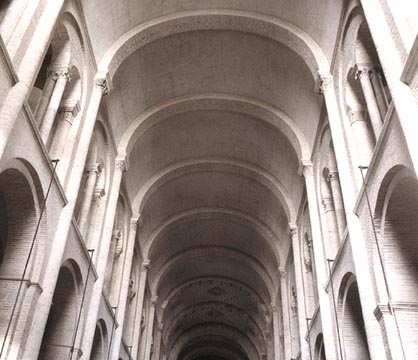


One of the most important things of the Romanesque period having to do with architecture is the use of vaulted ceilings. The three main types that were heavily used are the barrel vault, the groin vault, and the ribbed vault. Starting with the barrel vault, it is a semicircle arch that is stretched out to created a ceiling.(Below Images 1 and 2) It can be compared to half of a hollowed out rolling pin. This is the oldest style of vaulted ceiling and the Romanesque period pushed it to its limits. The groin vault is pretty much two of the barrel vaulted ceilings stuck together at a right angle.(Below Image 3) These hold their weight on pillars. As for the ribbed vault, they have more of little arch frames, and they spread the weight out even more through pillars than the groin vault. That is why these are popular, due to their excellent strength, they allowed for higher, wider and heavier structures to be placed on top of them. (Below Image 4)
Extra Credit Video:
https://www.youtube.com/watch?v=_zzO1pmjUYM
About the Leaning Tower of Pisa, one of the most important Romanesque buildings.
Friday, February 5, 2016
Byzantine Reviews
Angie: I really like the first image Angie used because its shows the different parts of the building.
Becca: I really like the way all the images are set up, I like that the pictures are by the words that they relate too.
Becca: I really like the way all the images are set up, I like that the pictures are by the words that they relate too.
Wednesday, February 3, 2016
Byzantine
One of the most important Byzantine pieces of Architecture is the Hagia Sophia, which can also be known as the Church of the Holy Wisdom. This was designed by Anthemius of Trails and Isidor of Miletus. To show how important and influential the building was there was an Enormous dome. This dome was s so massive that it collapsed multiple times in the construction alone! With domes, especially of this size, there is a very important way that the weight needs to be distributed. Here the pendentive method was used. A pendentive is used to support the dome on a square base so the weight is distributes (picture of pendentive below) .

The interiors of these buildings were also something to look at. The buildings that still exist and were found are mainly churches, so alot of what we know is from the churches and their styles. Flooring was typically marble tiles, which were usually in geometric patterns and designs. Floor tiles are also much more heavy duty and durable than the wall tiles. Also a cool part about the interiors of the buildings is that on the surfaces whether it be walls or ceilings they were heavily ornamented. These ornamental aspects include, anything from marble, frescoes or clebaster.


(Hagia Sophia mentioned above)
Current Applications


Extra Credit Video
https://www.youtube.com/watch?v=zwLEOe7gnRo
The interiors of these buildings were also something to look at. The buildings that still exist and were found are mainly churches, so alot of what we know is from the churches and their styles. Flooring was typically marble tiles, which were usually in geometric patterns and designs. Floor tiles are also much more heavy duty and durable than the wall tiles. Also a cool part about the interiors of the buildings is that on the surfaces whether it be walls or ceilings they were heavily ornamented. These ornamental aspects include, anything from marble, frescoes or clebaster.
(Hagia Sophia mentioned above)
Current Applications
Extra Credit Video
https://www.youtube.com/watch?v=zwLEOe7gnRo
Subscribe to:
Comments (Atom)